What if AI wasn’t something your bank added, but the foundation it was built on?
That was the question I came away with after chatting with Bianca Zwart, Chief Strategy Officer at bunq, to unpack what it truly means to be AI-native.
For bunq, AI isn't a feature bolted onto an existing model. It's the operating system.
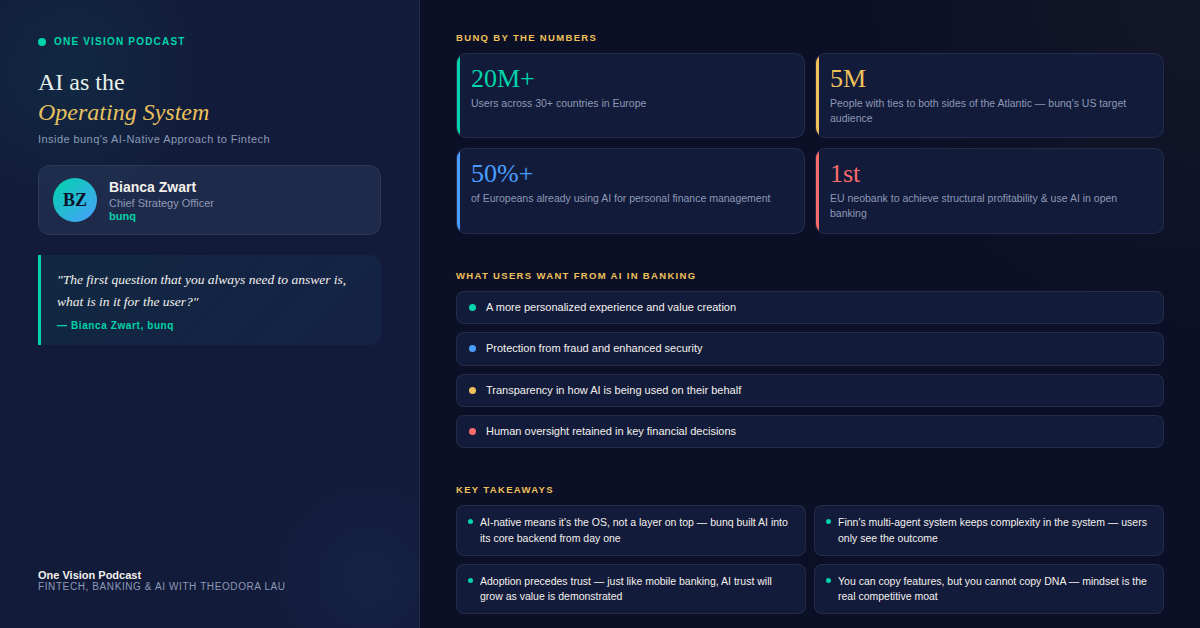
Here are three key takeaways from our conversation:
[1] AI as the operating system, not a feature.
Most institutions are asking how AI can make existing processes faster. bunq starts with a completely different question: what does the user need?
AI is embedded in their core backend — not bolted on top — powering everything from Finn, their personal AI money assistant, to real-time internal product feedback loops.
[2] The next frontier: user as supervisors, not operators.
Finn already coordinates behind the scenes so users get one clear answer instead of being passed around. What's next? Proactive, agentic nudges. Imagine your bank alerting you that your Spotify subscription quietly went up, before you notice it on your statement.
[3] You can copy features. You cannot copy DNA.
Bianca put it simply: traditional players can add AI tools, but if the underlying mindset isn't user-first, it won't matter. The real competitive advantage isn't the technology. It's the culture.
bunq has formally filed for a US de novo banking license with the OCC, targeting the 5 million people navigating financial life on both sides of the Atlantic who are deeply underserved by today's banking infrastructure.
If you missed our conversation, give the full episode a listen ... wherever you listen to podcasts.
“The first question that you always need to answer is, what is in it for the user?”
Episode Transcript
1
00:00:04.940 --> 00:00:13.160
Hello, everyone. Welcome to a brand new episode of one vision. This is Theo, your host for today's episode.
2
00:00:13.840 --> 00:00:23.960
Joining us from the other side of the ocean is Bianca Zwart, chief strategy officer at bunq. Welcome to the show, Bianca.
3
00:00:24.180 --> 00:00:26.100
Thank you. Thank you so much for having me.
4
00:00:26.100 --> 00:00:45.440
Good to see you virtually, at least sort of after running into you in London. So I have so many questions for you with regards to what AI is doing with bunq because I've been following you guys for a while now and what your plan is to the US market.
5
00:00:45.440 --> 00:00:47.400
So I'm very excited for the conversation.
6
00:00:48.520 --> 00:00:55.320
So let's start off with the buzzword of the last five years, AI.
7
00:00:55.320 --> 00:01:17.000
Everyone is talking about AI, but I remember when I first started reading about what you're doing is actually because of AI and I read about it from one of the Nvidia conferences, where they were talking about how AI is playing a really important role at bunq.
8
00:01:17.000 --> 00:01:30.680
At that time when most of the financial institutions are still talking about whether we should use it, where can we use it? But with bunq, you have already had it right in, in the core of everything that you do.
9
00:01:30.680 --> 00:01:46.040
So can you walk us through from a, you know, you're from your perspective, how the technology has been deployed for users today? That's a traditional banking app simply cannot do because you got to start from it from the very beginning.
10
00:01:46.080 --> 00:01:48.200
And where do you see it going next?
11
00:01:49.140 --> 00:01:50.860
Oh, exciting questions.
12
00:01:51.300 --> 00:01:56.760
I'll start at the beginning and whenever you have any extra questions, please, please interrupt.
13
00:01:58.720 --> 00:02:02.520
We indeed have been working with AI for a very, very long time for years.
14
00:02:03.860 --> 00:02:20.420
I think partly that is because we're a real tech company, tech is in our DNA. So whenever we look at a problem or an opportunity, the first thing that we think of is how can we use technology to make this easier or safer or whatever it is that we're trying to achieve.
15
00:02:20.420 --> 00:02:22.360
And the same goes for AI.
16
00:02:23.600 --> 00:02:26.000
And it's a very interesting
17
00:02:27.480 --> 00:02:35.940
difference, I think, if you look at the way we deploy AI and the way traditional players do, even if they do it in the first place.
18
00:02:35.940 --> 00:02:45.300
I noticed a lot of the conversation there is about efficiency, right? How can we do the things that we're already doing, but do them faster?
19
00:02:45.900 --> 00:03:00.360
And for us, it is very much a different conversation. It's, we use AI to stay user centric at scale, right? Give users the best experience wherever they are, 24-7, whatever language they speak.
20
00:03:00.360 --> 00:03:09.260
So we start with the user problem or the thing we want to share with them or the way in which we want to make their life easy.
21
00:03:09.400 --> 00:03:20.500
And then we build around it. And in that sense, it's quite special because we are AI native. So we've built AI directly in our back end.
22
00:03:20.500 --> 00:03:28.220
So in that sense, it's not a layer on top. It's the operating system. So you could compare that to
23
00:03:28.220 --> 00:03:34.960
downloading a feature or another feature, an app from the app store on your phone or your Apple operating
24
00:03:35.640 --> 00:03:41.840
system. We are really much in the Apple operating system rather than adding it as a layer on top.
25
00:03:44.240 --> 00:03:50.900
And as part of all the amazing developments that we've built, we've built our own Gen.Eye platform.
26
00:03:51.280 --> 00:03:58.780
It's called Finn. I'm not sure if you heard about it or read about it before. And Finn is really at the core of everything we do.
27
00:04:00.380 --> 00:04:08.820
So whether that's contact with our users or whether that is reviewing code for our engineers, but it's also
28
00:04:08.820 --> 00:04:18.220
I think partly what makes it so interesting is that not just the user side, but also internally, thanks to AI, we can see
29
00:04:18.220 --> 00:04:24.800
real time where users struggle or what needs to be clear, what the most recurring bugs are.
30
00:04:24.820 --> 00:04:28.920
And we can feed that directly into product improvements.
31
00:04:31.660 --> 00:04:37.240
Well, I did not know about that second part. That's actually that's really, really cool.
32
00:04:38.000 --> 00:04:42.540
I have a question on that, because everyone is talking about Gen.Eye.
33
00:04:43.640 --> 00:04:51.540
And then, you know, for the last half year or so, we're now evolving into a Gen.Tik AI and how can we deploy agents to make things
34
00:04:51.540 --> 00:05:02.640
easier and do things for us. So with that regards, you know, with agents taking actions on users behalf, where do you see this going from your
35
00:05:02.640 --> 00:05:04.700
perspective, how you're deploying it?
36
00:05:05.020 --> 00:05:16.560
Yeah, that is a very interesting question, because well, it's hard to predict the future, but I'll look at what I see right now and what is likely to follow from there.
37
00:05:17.040 --> 00:05:26.620
So if I look at Finn, for example, in the way that it's set up, it's not just a chatbot, right?
38
00:05:26.620 --> 00:05:33.500
It's so much more than that. The way that we've built Finn, we have multiple agents that communicate amongst each other.
39
00:05:33.680 --> 00:05:37.260
One agent understands, for example, what the user is asking.
40
00:05:37.640 --> 00:05:46.980
The other agent fetches the right information, checks transactions or suggests solutions, and they coordinate automatically together.
41
00:05:46.980 --> 00:05:52.400
And then the user gets one clear answer instead of being passed around, right?
42
00:05:52.640 --> 00:05:56.440
Because before AI, systems were very linear.
43
00:05:56.660 --> 00:06:03.660
You'd ask a question and then either a person or a system would handle one part of it.
44
00:06:04.520 --> 00:06:09.220
And if it got more complex, you get passed along different teams, different tools, different steps.
45
00:06:10.160 --> 00:06:15.060
So the burden was always on the user to navigate that complexity.
46
00:06:15.740 --> 00:06:22.540
And now, because all the agents are coordinating automatically in the background, you really see that the complexity stays in the system.
47
00:06:22.660 --> 00:06:26.660
So the user only gets the outcome of it.
48
00:06:27.700 --> 00:06:33.880
So where do I see this going? Of course, safety is very important, especially when it comes to your money.
49
00:06:34.600 --> 00:06:41.320
So at this moment, AI is not necessarily taking actions on your behalf, but AI can, of course, do.
50
00:06:41.320 --> 00:06:46.380
And I think that is the next phase that we're going in. It suggests solutions, right?
51
00:06:48.940 --> 00:06:54.440
Proactively flag something that's coming up that you might need to take into account.
52
00:06:55.500 --> 00:06:59.420
For example, let me give a very tangible example.
53
00:07:01.480 --> 00:07:10.480
Let's say you pay a Spotify subscription and all of a sudden Spotify increases their prices and you miss the email on that.
54
00:07:10.480 --> 00:07:14.160
But Finn notices that the subscription price goes up.
55
00:07:14.560 --> 00:07:20.380
Finn can send you a message and say, hey, I noticed that your subscription for Spotify went up.
56
00:07:21.540 --> 00:07:25.220
Do you still want it or is it some action that you need to?
57
00:07:26.640 --> 00:07:31.720
Is it some action that you want to take accordingly or whether that is a payment?
58
00:07:32.980 --> 00:07:37.960
Really making sure that the user becomes more like a supervisor rather than an operator.
59
00:07:39.160 --> 00:07:47.640
I love that example. I can literally think of there have been so many instances I needed something like that.
60
00:07:47.860 --> 00:07:53.820
And it's often after the fact because you missed the email because it somehow went to a junk box.
61
00:07:54.440 --> 00:08:01.460
And by the time you look at the statement like, whoa, wait a minute, what just happened?
62
00:08:02.400 --> 00:08:06.280
I wish I had something like that with my institution.
63
00:08:06.660 --> 00:08:08.380
I mean, that would have been lovely, right?
64
00:08:08.780 --> 00:08:16.280
It's like what you say, making it work for the users and thinking of it from a user centric perspective.
65
00:08:16.360 --> 00:08:24.020
How can we do things better and how can we help them improve their financial well-being and be smarter with their money?
66
00:08:24.400 --> 00:08:26.420
I think we all need a little bit of that.
67
00:08:26.420 --> 00:08:29.720
So speaking of, I wish I would have.
68
00:08:30.020 --> 00:08:33.419
I was going to jump into there, but I think we know where we're going.
69
00:08:33.780 --> 00:08:34.620
Please don't.
70
00:08:36.080 --> 00:08:38.220
You knew what I was going to ask you next.
71
00:08:39.780 --> 00:08:46.580
So a lot of European neobanks have struggled to actually make it work here.
72
00:08:46.920 --> 00:08:53.540
Now, you guys are going to start that journey with the OCC approval.
73
00:08:53.540 --> 00:09:02.100
So what's different with how you're approaching the US market, especially since we are pretty crowded here.
74
00:09:02.460 --> 00:09:06.380
There are already a lot of financial institutions that's been here forever.
75
00:09:06.720 --> 00:09:16.480
And then now we're getting a big wave of new neobanks coming from all parts of the world, literally trying to establish a footprint here.
76
00:09:16.920 --> 00:09:20.480
So anything you could share with us on your secret sauce?
77
00:09:20.480 --> 00:09:23.720
I could talk about this for hours, so stop me when it's too much.
78
00:09:23.860 --> 00:09:25.340
I'm very excited about this.
79
00:09:26.180 --> 00:09:29.320
So we indeed, the US is our next big bet.
80
00:09:29.480 --> 00:09:35.480
We applied for a banking license in January, and I'm very, very excited about it.
81
00:09:35.680 --> 00:09:39.460
And you rightfully say that it's a very complex market.
82
00:09:40.400 --> 00:09:43.400
It's a very big market, very fragmented.
83
00:09:44.080 --> 00:09:48.580
And we're not going to go in pretending that we know everything about everyone.
84
00:09:48.580 --> 00:09:54.420
But we're going to go in with a proven model.
85
00:09:55.020 --> 00:10:03.640
So our success in Europe is due to us understanding and catering to an audience that by nature is global,
86
00:10:04.420 --> 00:10:09.360
that live an international lifestyle, whether those are expats, travelers, you name it.
87
00:10:09.720 --> 00:10:13.040
And we really cater our product to that audience.
88
00:10:13.040 --> 00:10:23.540
We listen to their needs, really obsessed about one specific audience rather than catering to everyone and therefore catering to no one.
89
00:10:24.480 --> 00:10:27.520
So going into the US, that's also the group that we're targeting.
90
00:10:29.220 --> 00:10:36.400
So there is a group of, I believe it's five million people with ties to both sides of the Atlantic,
91
00:10:36.400 --> 00:10:44.800
whether that's European expats in the US or US expats in Europe that need a better way to manage their money.
92
00:10:45.240 --> 00:10:58.540
Because if I were to move to the US tomorrow as a European citizen, it would be very, very difficult, if not impossible, to open a bank account for me.
93
00:10:59.000 --> 00:11:01.100
We see that for students as well.
94
00:11:01.100 --> 00:11:09.740
There are a lot of systems you have to go through as such a user, and it's very tedious and painful.
95
00:11:10.260 --> 00:11:17.900
And we are going to make life easier for these people and also cater them on both sides of the Atlantic.
96
00:11:19.280 --> 00:11:25.440
So making sure that they can handle their finances in Europe and in the US from one app.
97
00:11:28.510 --> 00:11:42.650
That's literally to your point, is a very specific group of people which, you know, they're not being well served because you have to reestablish your credit, you have to redo all of that.
98
00:11:43.550 --> 00:11:55.370
And without some of the foundational stuff, you can't even get, I don't know, like a rent, rental agreements, any of those very basic things we take for granted.
99
00:11:55.370 --> 00:11:59.030
A credit card in the US is the way to pay, right?
100
00:11:59.670 --> 00:12:05.370
In Europe, we don't really do credit cards, or at least we don't really do credit as...
101
00:12:05.890 --> 00:12:07.190
Not the way that we do here.
102
00:12:07.410 --> 00:12:10.830
Exactly. So by default, we don't have a credit score.
103
00:12:11.230 --> 00:12:14.990
And in order to open accounts or have a credit card, you need that.
104
00:12:15.090 --> 00:12:17.250
And that's a big friction point.
105
00:12:17.810 --> 00:12:26.270
It is definitely indeed. And when you were talking with the five million people, give and take, that is going between both continents.
106
00:12:26.970 --> 00:12:31.250
Just literally, in my friend group alone, there are plenty of them.
107
00:12:32.570 --> 00:12:38.490
Yeah, like literally recently, I remember a friend of mine, he's moving his family to the UK.
108
00:12:38.770 --> 00:12:44.350
And he pinged me, he's like, I don't know what to do, I need a bank account here.
109
00:12:45.050 --> 00:12:46.930
Where does one start?
110
00:12:47.230 --> 00:12:52.110
Yeah, he's like, where do I start? I don't want to go to a bank branch.
111
00:12:52.110 --> 00:12:53.830
I'm like, oh my god, please don't do that.
112
00:12:54.390 --> 00:13:00.170
So it is definitely interesting. We're all digital nomads and a lot of sons.
113
00:13:01.590 --> 00:13:06.890
So talking about going back a little bit about value creation, about what users want.
114
00:13:07.740 --> 00:13:16.790
In the very beginning, you talked about how most people, even now in our industry, when we talk about deploying AI, deploying technology,
115
00:13:17.270 --> 00:13:25.910
we talk about cutting headcount, we talk about efficiency, we talk about, you know, more centric to back office,
116
00:13:26.010 --> 00:13:34.990
to how organizations can gain from the technology, but less so about improving user experience.
117
00:13:35.750 --> 00:13:41.430
How do you think that's, well, actually, it's a two part question.
118
00:13:41.730 --> 00:13:47.750
One is, do we think the industry in general is doing enough to bridge both? Because I think we need both.
119
00:13:48.950 --> 00:13:57.790
Is there specific pots that we do better? And B, more importantly, how do we bring more people into the fold
120
00:13:57.790 --> 00:14:03.410
so that we can adopt a technology in a way that is responsible, that is useful?
121
00:14:03.970 --> 00:14:10.970
I think we struggle with that, right? I feel like we are like little squirrels running around like, oh, this is so cool.
122
00:14:11.110 --> 00:14:16.850
We can do this. We can do this. We can do this. And then we kind of lose track on, oh, wait a minute.
123
00:14:16.890 --> 00:14:17.910
What about the users?
124
00:14:19.610 --> 00:14:25.810
Yeah, what about the users? Yeah, that's what about them, which is funny because you're totally right.
125
00:14:26.870 --> 00:14:33.310
But it's a very different experience than what I have because at bunq we're very much focused on the users.
126
00:14:34.310 --> 00:14:39.870
We have been since the start before AI and we still are now quite literally so.
127
00:14:40.030 --> 00:14:45.430
So, for example, if you were to come up with a business proposal, if you work at bunq,
128
00:14:45.650 --> 00:14:48.530
we have a template to make sure that everything is consistent.
129
00:14:49.510 --> 00:14:54.250
The first question that you always need to answer is what is in it for the user?
130
00:14:54.250 --> 00:14:59.450
And if you cannot answer that question, we're not going to do it.
131
00:14:59.830 --> 00:15:06.970
So in that sense, that is a very different approach than perhaps the more traditional players.
132
00:15:07.030 --> 00:15:16.530
And I think when it comes to AI, I indeed see the conversation being about efficiency and not just that.
133
00:15:16.530 --> 00:15:23.490
It's being treated as a tool on top like Slack, right?
134
00:15:23.490 --> 00:15:28.610
Now we have we had Slack and now we have AI and that's how we're going to I know it's ridiculous.
135
00:15:28.610 --> 00:15:32.470
But that's how I that's how I see it being used.
136
00:15:32.550 --> 00:15:36.470
Well, for me, it's something more fundamental. AI is not a tool.
137
00:15:36.750 --> 00:15:39.090
You should treat it as a decision layer. Right.
138
00:15:39.090 --> 00:15:45.190
So how do decisions how are decisions made within a company?
139
00:15:45.290 --> 00:15:46.870
How does information flow?
140
00:15:47.350 --> 00:15:54.210
How can we make use of AI in order to do it in such a way that it actually helps us solve problems
141
00:15:55.090 --> 00:15:58.970
for our users instead of just cutting head counts?
142
00:15:58.990 --> 00:16:01.910
Because at the end of the day, that doesn't really bring you anywhere.
143
00:16:02.790 --> 00:16:07.590
And when it comes to traditional players, I cannot speak on their behalf and I will never do that.
144
00:16:10.210 --> 00:16:15.430
But I know there's a difference mainly in in in mindset.
145
00:16:15.730 --> 00:16:26.290
Right. When I say that we are a a tech company, that doesn't mean just the tech.
146
00:16:26.670 --> 00:16:29.030
It is a there is a mindset to it.
147
00:16:29.110 --> 00:16:34.670
I said it in the beginning, I believe when we look at a problem, we look at it from a user perspective.
148
00:16:34.670 --> 00:16:40.610
We look at it from how can we use technology to solve a problem?
149
00:16:40.690 --> 00:16:47.750
And I noticed that in traditional companies, it's rather a we have very complex systems.
150
00:16:47.750 --> 00:16:51.170
How do we use AI to make that faster?
151
00:16:51.190 --> 00:16:59.250
And if they're not able to simplify what is underneath or to to change that mindset,
152
00:16:59.250 --> 00:17:04.210
I don't think it will bring much because you can copy features, but you cannot copy DNA.
153
00:17:05.369 --> 00:17:07.790
Oh, my God. That is so very true.
154
00:17:08.089 --> 00:17:13.930
It's like when I look at founders, right, for example, when they present something,
155
00:17:14.670 --> 00:17:22.450
typically the first question I often ask and I'm most curious about is who exactly are you
156
00:17:22.450 --> 00:17:27.609
and why are you doing what you're doing? Because that is the reason that that's what drives them.
157
00:17:27.609 --> 00:17:31.430
You can present any proposals, you can tweak the proposals.
158
00:17:31.510 --> 00:17:33.230
Those are things that come after that.
159
00:17:33.470 --> 00:17:39.490
But the few that pushes you, the passion that keeps you up, especially when things get hard,
160
00:17:40.170 --> 00:17:42.330
that is your personality. That's your DNA.
161
00:17:42.410 --> 00:17:45.410
That's the reason why you're doing what you're doing and your character.
162
00:17:45.530 --> 00:17:47.830
You can't change your character, right?
163
00:17:48.310 --> 00:17:52.370
And the character is precisely the mindset you're talking about in a company.
164
00:17:53.090 --> 00:17:54.930
Exactly, because there will always be a new tool, right?
165
00:17:54.930 --> 00:17:56.910
There will be new technology.
166
00:17:57.930 --> 00:18:03.230
So in the end of the day, it's just means to an end at the end of the day.
167
00:18:04.270 --> 00:18:05.770
It is very much so.
168
00:18:05.770 --> 00:18:08.010
And it's so hard to stay focused.
169
00:18:08.290 --> 00:18:12.110
And I'm speaking it like from even my personal perspective, right?
170
00:18:13.010 --> 00:18:17.870
You have these tools and then you're like, wow, I can do all these things now.
171
00:18:18.130 --> 00:18:20.210
And the next thing you know, like, oh, what about this?
172
00:18:20.290 --> 00:18:21.890
What about this? What about this? What about this?
173
00:18:21.890 --> 00:18:25.330
And I get I am literally getting mentally exhausted.
174
00:18:25.690 --> 00:18:31.770
And some days like maybe, you know, we all need to focus back on exactly what we do, what we're doing.
175
00:18:32.010 --> 00:18:34.370
Yeah, while you were using those tools in the first place, right?
176
00:18:34.590 --> 00:18:36.730
What was the goal you were trying to achieve?
177
00:18:37.630 --> 00:18:39.710
And it's easy to lose sight of that.
178
00:18:40.530 --> 00:18:48.110
So anchoring, re-anchoring, what do you think users would be open to?
179
00:18:48.110 --> 00:18:55.830
You know, fintechs and the providers using technology for it, because there's a question that starts popping up here.
180
00:18:56.950 --> 00:19:05.550
The way that we view privacy and all of that is a little bit different, unfortunately, to the guardrails that EU has.
181
00:19:05.930 --> 00:19:10.010
Right. And so as of late, a lot of questions start popping up.
182
00:19:10.410 --> 00:19:15.410
How do consumers view their provider using technology?
183
00:19:15.530 --> 00:19:17.550
Are they OK with it? Are they not OK with it?
184
00:19:17.550 --> 00:19:25.130
And then how are banks and fintechs viewing their communication of their use of AI for their customers?
185
00:19:25.670 --> 00:19:29.730
And overwhelmingly, it seems like the top two things keep popping up.
186
00:19:29.910 --> 00:19:36.570
One is, are you using AI to create better and more personalized experience for me to create value for me?
187
00:19:36.850 --> 00:19:41.610
And then the second one is, are you using AI to protect me? Right.
188
00:19:41.610 --> 00:19:48.270
So from fraud perspective, which, by the way, actually, that was how I first started following bunq and what you guys are using on fraud.
189
00:19:50.050 --> 00:19:54.890
So those two are the top two things that it seems like consumers are OK with.
190
00:19:55.890 --> 00:19:59.870
Is that something similar that you see with your users as well?
191
00:20:00.230 --> 00:20:04.810
Yeah, I think there was a research that we did the other day.
192
00:20:04.810 --> 00:20:07.550
I'm more than happy to share the results with you later.
193
00:20:07.550 --> 00:20:10.330
I don't remember them all from the top of my head.
194
00:20:10.950 --> 00:20:25.510
But basically what it came down to is that more than half of the people that were surveyed and we surveyed the European audience already uses AI for their personal finances.
195
00:20:25.510 --> 00:20:31.710
So they already do, whether that's through their app or through another tool.
196
00:20:32.270 --> 00:20:39.910
That wasn't the point of the research, but they're already adopting the technology for their personal finances, focused on, well,
197
00:20:40.150 --> 00:20:43.510
budgeting questions, but also as a sparring partner. Right.
198
00:20:43.830 --> 00:20:46.670
How can I better approach my money?
199
00:20:48.230 --> 00:20:53.230
And the interesting thing there is that they were using it.
200
00:20:53.290 --> 00:20:59.390
However, they still trusted human advice more than AI, which is logical.
201
00:21:00.670 --> 00:21:06.530
But it shows you that adoption often goes before trust.
202
00:21:06.850 --> 00:21:09.590
Trust takes longer to build and it makes a lot of sense.
203
00:21:09.590 --> 00:21:15.230
I think we've seen that with all advancements when it comes to technology.
204
00:21:15.810 --> 00:21:17.350
Take mobile banking, for example.
205
00:21:17.450 --> 00:21:22.590
I remember when that was new, people were very hesitant, although they did see the value, they were hesitant.
206
00:21:22.710 --> 00:21:25.910
And now it's something that we cannot live without.
207
00:21:26.110 --> 00:21:27.750
So I think it's very important.
208
00:21:27.910 --> 00:21:38.010
A couple of things are important as a company is obviously that you deploy AI safely and you have guardrails and
209
00:21:38.010 --> 00:21:40.830
focus on avoiding biases and all those things.
210
00:21:41.930 --> 00:21:52.130
But you also need to make sure the user at all times understands the value that they're getting, but also understands how you're using AI.
211
00:21:52.250 --> 00:21:58.130
So, for example, in our case, if the user is communicating with Finn, we always make sure it's very clear that that's the case.
212
00:21:58.470 --> 00:22:05.750
Right. And then gradually we can see how we can increase the value that we can provide in a way that our users
213
00:22:05.750 --> 00:22:10.250
still feel comfortable and make sure that we keep that trust.
214
00:22:10.930 --> 00:22:21.990
And you mentioned fraud because that's a very interesting one because we've been using AI for our fraud prevention for years.
215
00:22:22.670 --> 00:22:28.710
And that has been a very interesting journey, not necessarily on the technology side.
216
00:22:28.710 --> 00:22:44.670
We saw quite early on that using AI, we could keep our users so much safer than if we were to use a more rule based approach that was more common before that.
217
00:22:45.270 --> 00:22:48.570
However, the industry wasn't quite ready for it.
218
00:22:48.570 --> 00:23:03.390
Regulators were on the fence and we really put a lot of effort into making regulators understand that it's in the benefit of the safety of the consumer to start deploying AI.
219
00:23:04.590 --> 00:23:12.390
And now we got to the point where we can and also other banks in the Netherlands can, so that has been a great journey.
220
00:23:13.280 --> 00:23:35.910
That was amazing. I remember I forgot who presented it, but that was the first session that someone from actually from bunq was talking about how you're leveraging the speed of Nvidia platform to allow you to do machine learning and to adapt dynamically.
221
00:23:35.910 --> 00:23:47.870
And recreating models, retraining the models at a much faster pace to be able to keep up with the bad actors compared to precisely to your point, rules based.
222
00:23:49.130 --> 00:23:54.650
It didn't do a good job and so that's why you guys went with that route.
223
00:23:54.650 --> 00:24:06.630
And this was, I would say, at least three years ago, if not for even like beyond and that was the first time I heard of any company using them describing it that way.
224
00:24:07.210 --> 00:24:14.490
So that stuck with me. It was fascinating and kudos to you guys. So before I let you go.
225
00:24:14.490 --> 00:24:31.390
Oh, time flies. I have a question. Time flies. I'm looking at the clock. So before I let you go, I want to ask you, what keeps you up at night? What's the one thing that you worry the most? And then flipping the other side, what gives you hope on what you do?
226
00:24:31.850 --> 00:24:41.150
Beautiful question. I must say, disclaimer first, I can sleep anywhere. I could sleep sitting up here right now.
227
00:24:43.210 --> 00:24:54.470
So I don't necessarily have that problem. And in general, what I've noticed, because I actually was thinking about this last week, when I was talking to a friend of mine about a similar topic.
228
00:24:55.490 --> 00:25:15.790
If I do lie awake, it usually isn't about problems or things that need to be fixed. I usually lie awake because I'm excited about something, you know, like I want something to go faster or move faster. I want it to be tomorrow so we can do X.
229
00:25:15.790 --> 00:25:36.090
So in that sense, the US expansion is really keeping me awake in the best possible way. I cannot wait. Of course, the regulators are now looking at the application and they need their time to do a diligent job. But I cannot wait to go there.
230
00:25:37.270 --> 00:26:01.910
And then you asked me, what gives me hope? And that is a great question. What gives me hope is the people at bunq. I think I've been with bunq for a very long time. And we're growing really fast across different offices, different backgrounds, different perspective.
231
00:26:03.030 --> 00:26:22.010
But what I love so much about the people here is that we all, regardless of differences, we have one shared mindset. And that is simply wanting to improve things, not because it sounds good, or because it looks good on the CV, because we genuinely generally bothers us when things
232
00:26:22.010 --> 00:26:38.250
don't work for our users. Or, and yeah, generally, people will get very upset when something doesn't work. And when you are surrounded by that kind of drive, it's quite hard to not feel optimistic. That's it.
233
00:26:39.010 --> 00:26:54.430
Oh, I like that. I missed those days. That was a company I remember when I used to work at. And I think in the end, we our team just burned ourselves, because we just like we just kept going, going, going like, no, it has to work, it has to work.
234
00:26:54.430 --> 00:27:12.830
But it is contagious, right? Yes, the drive to fix something to make something better. For the people that you work with, for the people that you serve, that is a very contagious and positive mindset as well. So thank you so much for sharing that.
235
00:27:12.830 --> 00:27:18.150
And by the way, we're always looking for great people. So you can always, you know, we can talk about that later.
236
00:27:19.070 --> 00:27:38.090
Okay. All right. Well, until then, thank you so much for joining us on the podcast today. Appreciate your perspective. And I look forward to welcoming you guys on this side of the coast. And for the rest of our listeners, thank you so much for joining us for another episode of One Vision. We'll talk to you next week.