What Does Good Look Like? Tyler Spalding on Public Trust, Responsible AI, and the Future of Work.
What do the American people actually expect from companies deploying AI — and are corporate leaders listening?
In this episode of One Vision Podcast, Theodora Lau sits down with longtime friend Tyler Spalding, Chief Marketing, Communications & Engagement Officer at JUST Capital, to unpack the organization's latest research on how the public, investors, and corporate executives view AI's impact on society, jobs, and the economy.
They dig into the perception gap between public sentiment (66%) and corporate optimism (94% of investors and 90% of corporate leaders see AI as a net positive), and what that gap means for business leaders navigating workforce decisions, reskilling investments, and responsible AI deployment.
The conversation also explores the tension between AI-driven efficiency gains and the human cost of disruption — from layoffs framed as AI transformation and the anxiety facing the next generation entering the workforce, as well as the importance of defining and incentivizing responsible AI through consistent, comparable standards guided by public expectations.
📍Hot take: “ I've long believed that listening is a superpower.”
I had a lovely conversation with my longtime friend Tyler Spalding on One Vision Podcast recently.
We went deep on something that should be on every business leader's radar right now: the gap between how corporate leaders see AI and how the American public actually experiences it.
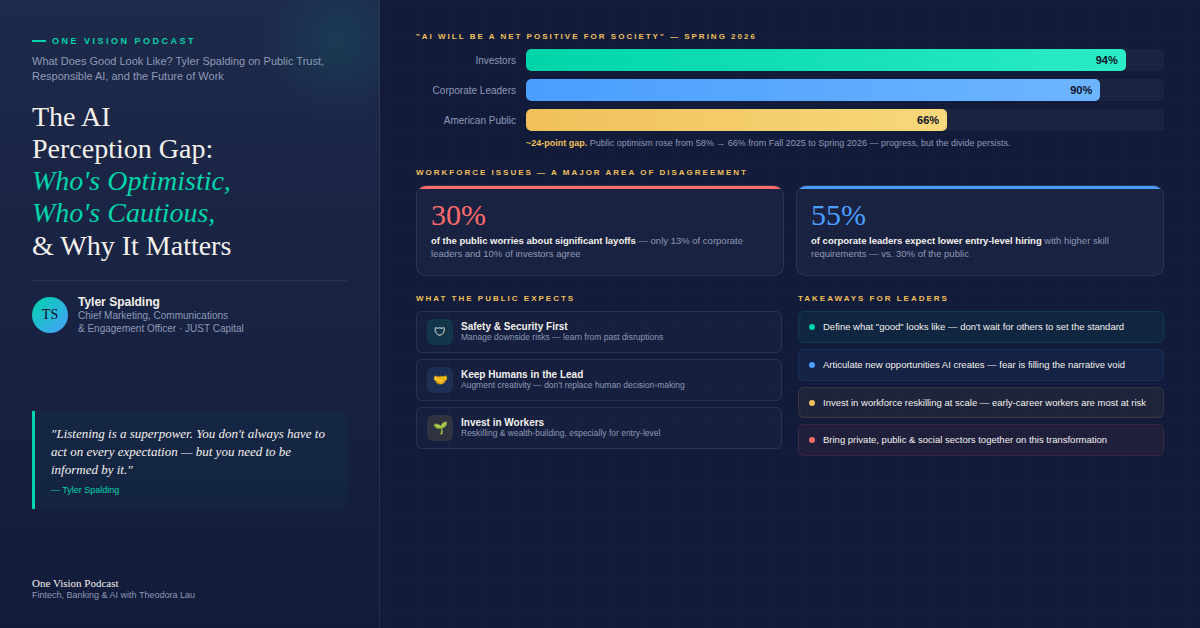
AI perception gap: Who’s optimistic, Who’s cautious, and Why it matters
Here are three key takeaways from our conversation:
[1] The perception gap is real — and it's a 24-point divide.
JUST Capital's latest research found that 94% of investors and 90% of corporate leaders believe AI will be a net positive for society within five years. Only 66% of the public agrees. That's up from 58% just one quarter earlier, which is encouraging — but the gap between the people making the decisions and the people living with the consequences remains significant.
The public isn't anti-AI. They see the potential. But they have high expectations around safety, transparency, and keeping humans in the lead. They want AI to augment what we do, not replace who we are.
[2] The workforce narrative is incomplete — and fear is filling the void.
30% of the public worries about significant layoffs due to AI, while only 13% of corporate leaders and 10% of investors see large-scale job losses ahead. Meanwhile, 55% of corporate leaders expect lower entry-level hiring with higher skill requirements.
Problem is, we haven't yet started to articulate what the new opportunities will be. What jobs will exist that we haven't even imagined? What entrepreneurial capacity gets unlocked? And how can we best protect workers' rights?
This is personal for me — I have two teenagers ... and I am worried about how the job market will look like when they graduate. Leaders in both the private and public sectors need to step up and shape that narrative.
[3] Listening is a leadership superpower — especially now.
Tyler said something that I absolutely loved "You don't always have to act on every expectation — but you need to be informed by it, and you need to be able to describe your decision-making accordingly."
JUST Capital has surveyed nearly 200,000 Americans over the past decade, and is now tracking AI perceptions on a regular basis, across the public, investors, and corporate leaders. The companies that get this right — investing in their workforce, deploying AI responsibly, being transparent about the trade-offs — will define the next decade. The ones that treat AI as a cost-cutting shortcut will lose the trust they can't afford to lose.
What gives me hope? People understand that change is coming. They want to be part of it. They want to be part of the positive impact. The question is whether leaders will meet them there.
If you missed our conversation, give the full episode a listen ... wherever you listen to podcasts.
“I have long believed that listening is a superpower.”
Episode Transcript
1
00:00:04.820 --> 00:00:09.920
Hello everyone, welcome to a brand new episode of One Vision.
2
00:00:10.240 --> 00:00:13.240
This is Theo, your host for today's episode.
3
00:00:13.840 --> 00:00:19.540
Joining us today is an old friend from prior life, Tyler Spalding,
4
00:00:19.720 --> 00:00:24.620
Chief Marketing and Communications and Engagement Officer at Just Capital.
5
00:00:24.980 --> 00:00:26.320
Welcome to the show, Tyler.
6
00:00:27.380 --> 00:00:28.900
Thank you very much, Theo.
7
00:00:28.980 --> 00:00:32.140
And I prefer long time friend, not old friend.
8
00:00:33.040 --> 00:00:35.140
Because I'm not too old quite yet.
9
00:00:35.140 --> 00:00:37.000
Getting up there, but not too old.
10
00:00:37.360 --> 00:00:39.960
That is true. That is very true.
11
00:00:40.160 --> 00:00:41.500
All right. Long time friend.
12
00:00:41.860 --> 00:00:48.140
Gosh, I would say at least seven, eight years, six, seven years, something like that.
13
00:00:48.840 --> 00:00:49.680
Yeah, time flies.
14
00:00:50.020 --> 00:00:51.240
Time flies.
15
00:00:51.780 --> 00:00:58.400
And the last time when we each had it and when, you know, I think it was in person.
16
00:00:58.400 --> 00:01:02.300
I wanted to say it could have been San Francisco or New York, one of the two.
17
00:01:02.740 --> 00:01:06.360
You were at PayPal and you were driving social innovation.
18
00:01:06.360 --> 00:01:09.040
And at that time, I was also in a different role.
19
00:01:09.580 --> 00:01:12.320
So much has changed since then.
20
00:01:12.720 --> 00:01:14.120
Can you catch us up to speed?
21
00:01:14.260 --> 00:01:16.220
And what is the latest with you?
22
00:01:16.460 --> 00:01:18.420
And what are you doing at Just Capital?
23
00:01:19.640 --> 00:01:26.920
Yeah, I mean, time really does fly a lot changes in such a short amount of time.
24
00:01:26.920 --> 00:01:32.760
I was at PayPal for all told about 12 or 13 years.
25
00:01:32.840 --> 00:01:36.240
I joined the company when eBay and PayPal were still one company
26
00:01:36.240 --> 00:01:39.560
and came through the PayPal separation
27
00:01:39.560 --> 00:01:45.220
and had, you know, a really rich set of professional experiences
28
00:01:45.220 --> 00:01:48.960
that I never could have imagined when I started at the company.
29
00:01:49.880 --> 00:01:55.040
And it's almost a year, maybe slightly longer than a year ago.
30
00:01:55.040 --> 00:02:01.860
I left after, you know, a couple of years leading our social impact
31
00:02:01.860 --> 00:02:05.220
and sustainability work on a global scale
32
00:02:05.620 --> 00:02:12.360
and felt like, you know, it was time for my next chapter of impact
33
00:02:12.360 --> 00:02:22.300
and to be able to bring forward sort of those experiences into a new chapter.
34
00:02:22.300 --> 00:02:29.920
And I consulted for about six months at an agency called Golan
35
00:02:29.920 --> 00:02:37.480
where I was really helping to elevate the firm's work on corporate affairs advisory services.
36
00:02:38.260 --> 00:02:45.640
And then I got the call for this newly established leadership role at Just Capital.
37
00:02:46.740 --> 00:02:54.100
Just Capital is an organization that I got to know quite well in my time at PayPal
38
00:02:54.100 --> 00:03:02.900
first as a corporate reporter on all of the rankings work that the organization was doing at that time.
39
00:03:03.180 --> 00:03:09.140
But then also, Just Capital was a really long term partner of PayPal's
40
00:03:09.140 --> 00:03:14.940
as we were working on all manner of employee financial wellness related work.
41
00:03:14.940 --> 00:03:23.380
And so got the call, spoke with Martin and many members of the board and the team here
42
00:03:23.380 --> 00:03:29.120
and felt like it was such a great opportunity to join the organization
43
00:03:29.120 --> 00:03:31.760
at a really important transformation moment.
44
00:03:32.660 --> 00:03:38.180
And it's been a wonderful ride ever since I've been here, I think about six or seven months now
45
00:03:38.180 --> 00:03:39.800
and having a lot of fun.
46
00:03:40.960 --> 00:03:43.980
It's funny, I can't believe it's only been six and seven months
47
00:03:43.980 --> 00:03:48.800
because somehow I felt like when I saw your change in role on LinkedIn
48
00:03:48.800 --> 00:03:54.840
I think it was one of the interviews that you did and you shared it on LinkedIn.
49
00:03:55.040 --> 00:03:56.500
I was like, oh yeah, that makes sense.
50
00:03:56.660 --> 00:04:01.340
And then I'm like, oh, double tick, wait a minute, that's a different company that you're working in.
51
00:04:01.900 --> 00:04:02.700
I love the cost.
52
00:04:03.440 --> 00:04:09.060
So before you shared that interview, I think the only thing I knew about Just Capital
53
00:04:09.060 --> 00:04:13.520
was the rankings, the companies to work for.
54
00:04:13.720 --> 00:04:14.560
I remember that part.
55
00:04:15.380 --> 00:04:21.320
And then when you showed up in the interview, I'm like, oh, wait, now there's a lot of reports and data points
56
00:04:21.899 --> 00:04:26.480
that is very useful when we try to make sense of what's going on in the world.
57
00:04:27.360 --> 00:04:29.560
So I'm so glad that you're here.
58
00:04:30.120 --> 00:04:35.480
So let's dive into one of the recent research that you guys conducted early in the year
59
00:04:35.480 --> 00:04:39.800
and that specific data point resonates.
60
00:04:40.720 --> 00:04:46.560
And I think it helps me bring the different dots together, if you will, of other reports that I've seen.
61
00:04:47.600 --> 00:04:49.660
You basically validated what we suspected.
62
00:04:50.340 --> 00:04:57.060
And this particular one was at 66 percent of the people that you had interviewed in this particular report
63
00:04:57.060 --> 00:05:03.260
for CAI being a net positive for society within the next five years.
64
00:05:03.260 --> 00:05:08.140
Now, that's higher compared to the last polling that was done in 2025.
65
00:05:08.980 --> 00:05:11.040
But there's nuance to it.
66
00:05:11.860 --> 00:05:19.240
That's a lower proportion of the public compared to how investors feel, which is 94 percent think is positive
67
00:05:19.240 --> 00:05:22.260
or corporate leaders think is 90 percent positive.
68
00:05:22.880 --> 00:05:26.040
So when you try to compare the two, right, there's a huge gap.
69
00:05:26.820 --> 00:05:33.820
We're looking at 30 something percent of difference between public sentiment versus those that are in the company.
70
00:05:34.580 --> 00:05:36.680
What do we make of that gap?
71
00:05:37.240 --> 00:05:42.620
And can we actually close it or this is just how the current tech cycle is going to be like?
72
00:05:43.660 --> 00:05:52.940
Well, I love the fact that you use the word nuance because that's exactly how we're describing this now, too.
73
00:05:52.940 --> 00:06:08.560
There's a lot of nuance in the way that the American public is perceiving the both opportunities and challenges presented by AI backing up a moment.
74
00:06:08.560 --> 00:06:22.660
You know, just capital is a decade plus has a decade plus worth of impact surveying the American public on the issues that matter most to them
75
00:06:22.660 --> 00:06:34.460
and then monitoring and tracking what companies are doing that meet or work to meet those expectations of the American public.
76
00:06:35.140 --> 00:06:37.600
As I said, we've been doing that for more than a decade.
77
00:06:37.600 --> 00:06:47.100
And since I've joined the organization in partnership with the rest of the leadership team here, we are continuing to do that rankings work.
78
00:06:47.140 --> 00:07:02.760
But we're also bringing forward that history of research, data and insights into a new just intelligence platform that enables just capital to be more than just an independent evaluator of company action.
79
00:07:02.760 --> 00:07:15.200
But but also a partner to companies as they're looking to optimize their stakeholder performance in service of, you know, growth and transformation.
80
00:07:15.200 --> 00:07:38.200
So it's about six or eight months ago or so now that we began to hear from companies directly, in addition to our own research and polling of the American public about, you know, AI and its transformative impact,
81
00:07:39.080 --> 00:07:43.180
both inside of companies and out and in the world.
82
00:07:43.340 --> 00:07:59.520
And we've now had two passes, two quarterly passes of surveying of not only the American public, but also investors, as you mentioned, and corporate leaders who are deploying AI at scale.
83
00:07:59.540 --> 00:08:03.000
And we're starting to see some really interesting responses.
84
00:08:03.000 --> 00:08:24.440
As you noted, you know, the percentage of the American public that is, you know, seeing the positive benefits of, you know, AI is growing, which, you know, stands in contrast a bit to, you know, some of the doom and gloom reports that we all see every day.
85
00:08:25.740 --> 00:08:38.720
And, you know, it's not totally a story of rising and uncertainty or rising fears of, of AI or or an impending AI backlash.
86
00:08:39.299 --> 00:08:42.919
You know, we're seeing that large portions of the American public.
87
00:08:42.919 --> 00:09:01.180
I think, especially as they're gaining more exposure to AI as they're using it more and more in their day to day lives or in their, in their work lives, that they're seeing, wow, there's a lot of, you know, cool things on the horizon.
88
00:09:01.180 --> 00:09:15.960
There are, you know, breakthroughs that we can imagine in health or in other parts of society that previously, you know, were hard to imagine how we would get there in our lifetime.
89
00:09:15.960 --> 00:09:30.700
So I think people are increasingly understanding, like, there's a lot of good that can come from responsible deployment of AI, but responsibility is sort of the, the kicker.
90
00:09:30.700 --> 00:09:42.520
There, there are also places in which the American public really does have high expectations of companies and AI innovators.
91
00:09:42.520 --> 00:09:55.540
They really do report in high percentages a strong expectation on, you know, safety and security and managing for downside risks.
92
00:09:55.660 --> 00:10:11.480
You know, learning the lessons of the past, if you will, around, you know, other technical, technological disruptions and the negative impacts that those or negative externalities that those breakthroughs have.
93
00:10:11.480 --> 00:10:37.920
And then also a high expectation of keeping humans in the lead and not letting AI sort of take over and kick, kick out, you know, human involvement, but really allowing people like you and me to be even more creative, be even, you know, more
94
00:10:37.920 --> 00:10:45.940
strategic in the thinking to be even more efficient and productive with what we can do in a given day.
95
00:10:46.240 --> 00:11:06.600
And so I think there's this this nuanced view, as you mentioned on the part of the American public, that there's a lot of opportunity and potential, but we need to also proceed with a lot of intention to make sure that we're deploying in a responsible manner.
96
00:11:08.340 --> 00:11:18.960
Proceed with caution. I remember that was one of the things I said a couple years ago when we saw Chachi BT came out was end of 2022.
97
00:11:19.960 --> 00:11:33.980
And I was like, wow, this is interesting, because, you know, we've been playing with tech for a while, you know, as you mentioned cycles of technology, but this is the last three years truly the first time that more people have access to different
98
00:11:33.980 --> 00:11:46.780
tools, and they can see it, they can play it, they can feel it, and it's different, it feels different, it feels more available, but it also feels the impact of it is a little bit bigger.
99
00:11:46.780 --> 00:12:07.960
To your point, there were a few other surveys I've seen recently, for example, a particular bank has released a survey around consumer sentiment of financial services using technology such as AI and majority of the people that were surveyed were okay with it as long as
100
00:12:08.680 --> 00:12:29.480
to help personalize the offers, prevent fraud, right, protect the assets of consumers, but majority of them are against it. If the tool is used to autonomously make decisions without the humans in the loop, to your point, you know, that part is important.
101
00:12:29.480 --> 00:12:46.640
So there's, there are things I think, you know, we need to learn how to balance. But with that being said, though, the one thing that is top of mind, especially in the last year, we've seen a lot of corporations using AI as an excuse, if you will, if you ask me, I think this was
102
00:12:46.640 --> 00:13:05.740
an excuse to do layoff. So people are concerned about unemployment, they're worried about, why am I in a position where I need to train the machine to replace me? What's going to happen to me or what's going to happen to, you know, my kids who are graduating from college, you know, are they going to be able to find jobs?
103
00:13:05.740 --> 00:13:23.600
So in the survey that you had, a third of the public are worried about significant layoffs because of the technology. And we've seen a lot of that. We've seen different banks coming out and say, you know, 10,000 here, 9,000 here, 20,000 here. It's like pulling magic number trick.
104
00:13:25.360 --> 00:13:41.260
What is interesting, though, is I think there are some that came out and said, No, we're not going to do layoff. We're going to try to find a way to re-skill the staff and find new roles for them. So I wanted to hear your thoughts.
105
00:13:41.260 --> 00:14:02.060
I think this spot is important, right? We know there is disruption. But what happens with that disruption around leadership skills, around investing in workforce, about balancing how they provide the returns back to shareholders because of gains from the technology versus taking care of their people.
106
00:14:02.820 --> 00:14:08.880
There are trade-offs that needs to be done and the needs that they need to take care of. So what do you think about that?
107
00:14:08.880 --> 00:14:26.540
Yeah, well, first of all, I think, you know, people are right to be concerned about their jobs and what the opportunities for wealth building and prosperity building are going forward.
108
00:14:26.540 --> 00:14:41.720
You know, I think, as you mentioned, many companies like this is not new. You know, many companies have been cycling through a lot of these, you know, reductions over many years.
109
00:14:42.540 --> 00:15:10.380
And, you know, it's not totally clear how much of them are directly attributable to AI versus other, you know, decisions. But it's also not hard to imagine in the not too distant future, especially once you start layering in humanoid robotics and other technological developments that there are, you know, there are likely to be, you know, some downsizing.
110
00:15:11.420 --> 00:15:35.140
Efforts across the private sector. I think, you know, what we haven't yet started to articulate is also what are the new opportunities that are going to be created with these new technologies and with the capacity of these new technologies.
111
00:15:35.140 --> 00:16:05.120
What new jobs are going to exist that we haven't even begun to imagine? What entrepreneurial capacity is going to be unlocked? You know, there are a lot of questions that I think, on the optimistic side of this as well, that are just as interesting for us to begin to start to think about together and for the private sector to begin to think about, you know, what is our narrative on, you know, what are the opportunities for wealth building?
112
00:16:05.120 --> 00:16:27.100
And I think it's important to start on talking about some of those things so that it's not just a, you know, job elimination story. That's one thing. And then the other is, as you've mentioned, reskilling and training. I think it's a moment for, you know, for doing that at scale.
113
00:16:27.100 --> 00:16:50.260
And for companies to really be investing in enabling their workforces to become, you know, not only AI literate, but AI, you know, powered in entirely new ways. And we're seeing a lot of leading companies that we speak with make, you know, make this a real priority.
114
00:16:51.320 --> 00:17:13.000
And, you know, and I think there's an opportunity for companies and the public sector to come together and think about what are new approaches to how we think about education, training, skilling, and economic opportunity for younger generations, you know, specifically.
115
00:17:13.000 --> 00:17:33.840
Because what we do know is that, you know, AI right now is having a particularly acute impact on early and entry level jobs. And so there is an opportunity right now for company leaders and the public sector to come together and think about.
116
00:17:33.840 --> 00:17:49.800
And also, you know, foundations in the social sector, frankly, to think about new ways to sort of enable young workers specifically to be able to participate and thrive in this new economy.
117
00:17:50.680 --> 00:17:57.020
I can't agree more. I have a 17, almost 17 year old, 16, gosh, time flies.
118
00:17:57.640 --> 00:18:10.980
So I have I have this teenager and in two years he's going to be in uni. And this topic of what should I study and what is the future going to be like and what should I even do? Right.
119
00:18:11.140 --> 00:18:14.460
That's been top of mind and we've been talking about it, you know.
120
00:18:14.460 --> 00:18:27.060
And I've seen what's been fascinating. I've seen his attitude towards AI. So he loves to experiment with that. He loves to download his own AI model.
121
00:18:27.520 --> 00:18:37.180
He is acutely aware of privacy concerns. He wants to have a way that he can guard how he use it and what information he shares.
122
00:18:37.180 --> 00:18:51.060
But he's been so creative with that, like he uses it recently to to look at stars, to map the patterns and to find ways to track different systems that he can take imaging off at night.
123
00:18:51.060 --> 00:19:00.840
And I'm like, oh, you came up with this. He's like, oh, yeah, I've been talking to, you know, Claude and, you know, this and then we created this program to do that.
124
00:19:00.840 --> 00:19:12.540
I'm like, oh, that that that that's pretty cool. Like the level of imagination that he has was was fascinating.
125
00:19:13.160 --> 00:19:17.540
At the same time, of course, you know, as a parent, I'm acutely concerned.
126
00:19:17.860 --> 00:19:24.200
Like, OK, if you want to go to computer science, chances are when you come out, there won't be any job for coding.
127
00:19:24.200 --> 00:19:29.500
But what might you be doing right? The what might you be doing is the pot.
128
00:19:30.300 --> 00:19:41.580
To your point, I think I would love for us to to to spend more time on between private public sectors, because that's where I think leadership is important.
129
00:19:41.980 --> 00:19:47.200
It's not enough to just sit here and say, well, you know, you're going to have more free time to do things.
130
00:19:47.200 --> 00:19:56.460
Well, it's kind of hard to articulate to people who are on the verge of losing a job and say, what am I going to use my free time for when I don't have a job?
131
00:19:56.860 --> 00:19:59.700
So I would love to see more of that for sure.
132
00:20:00.120 --> 00:20:02.880
Yeah. And I I totally agree.
133
00:20:02.880 --> 00:20:19.660
And I think, you know, now is the time right now is the time for for leaders to be thinking, you know, about these opportunities and thinking about what's going to be necessary for the next generation.
134
00:20:19.720 --> 00:20:23.740
And frankly, sort of what legacy do they want to leave?
135
00:20:23.740 --> 00:20:42.300
You know, looking back in 10 years, looking back on the past decade, you know, what do they want to say, you know, they did and the impact that they had during, you know, what is such a consequential transformation
136
00:20:43.720 --> 00:20:55.200
that really cuts at cuts to the core of capitalism and so much of who we are and what we stand for, you know, here in the U.S.
137
00:20:55.220 --> 00:21:06.120
And so I think that's the opportunity that we see here at Just Capital to help catalyze, you know, many of those conversations, bring forward data and insights that can enable
138
00:21:07.080 --> 00:21:26.160
leaders to, you know, be thinking about these kinds of opportunities in, you know, different ways and to be thinking about, you know, the decisions that they need to be making guided by, you know, the voice of the American public and their expectations in this in this moment.
139
00:21:26.620 --> 00:21:29.960
So there's a lot of work to do for sure.
140
00:21:31.200 --> 00:21:35.400
There's definitely a lot a lot of work to do to your point.
141
00:21:36.120 --> 00:21:43.100
As you put forth the data right you've mentioned there's been two quarters already and I assume there will be more to come.
142
00:21:43.920 --> 00:22:00.580
What will be the message that you would want to get to the corporate leaders, investors, you know, public sectors who are reading that report as you try to articulate, for example, earlier you talk about what what the public wants, right?
143
00:22:00.620 --> 00:22:09.000
Something that is responsible, something that is transparent, something that's safe. What would that particular message be for them? What should they look for?
144
00:22:09.000 --> 00:22:23.320
Yeah, I mean, I think we're in a really interesting moment where if you ask 10 different people, you know, what does responsibility in the AI powered economy mean to you, you're likely to get 10 different answers.
145
00:22:24.120 --> 00:22:52.410
It's sort of similar to maybe the beginning of like the climate movement or, you know, there could be other analogies, I'm sure, but where, you know, there isn't actually a consistent and comparable definition around what responsible development and deployment of AI means or, you know, where I think a lot of
146
00:22:53.530 --> 00:23:10.250
A lot of that still remains to be sort of aligned around. And so a lot of our hope for sort of entering into this research exercises to help to to do that.
147
00:23:10.250 --> 00:23:23.010
You know, we don't have the all the answers ourselves, of course, but we do have this polling and surveying capacity and we are, you know, tracking what companies are doing, what they're disclosing.
148
00:23:23.010 --> 00:23:44.690
And our hope is that, you know, over the next several months, over the next year, that we are able to, you know, really start to define what those key critical issues are and what good looks like, where there's more progress to be had.
149
00:23:44.690 --> 00:23:59.390
And to do that again in a way that becomes more consistent and comparable across certainly the Russell 1000, but perhaps also, you know, perhaps also beyond.
150
00:23:59.390 --> 00:24:13.510
And so there, that's the opportunity that we see. And I think when we speak with corporate leaders, when we speak with, you know, board members, etc.
151
00:24:14.170 --> 00:24:30.810
I think there's a lot of appetite to, you know, have that information and that insight to help guide decision making and frankly not feel like, you know, if you're if you're on a management team in one company that you need to, you know, totally reinvent the wheel.
152
00:24:30.810 --> 00:24:48.270
That you can, you know, begin to start to see a sense of, okay, what do my stakeholders expect? What are other companies doing? Where are we starting to see that there's a lot of convergence around those expectations and then be able to act accordingly.
153
00:24:49.130 --> 00:24:55.090
And over time also then incentivize those kinds of responsible actions.
154
00:24:56.590 --> 00:25:10.110
The incentivize is the important part. And I think we need we'll need to stop someone having the data is a great starting point. And as you say to inform what does good look like I wrote that down because I love that so much.
155
00:25:10.970 --> 00:25:21.770
And there's a lot we can hope for you know earlier in the conversation you talked about the breakthroughs right in medical field, we could potentially cure diseases that we otherwise couldn't do.
156
00:25:21.770 --> 00:25:27.910
And financial services, we can help people save better and plan better. They have a future to look forward to.
157
00:25:28.650 --> 00:25:42.110
You know, obviously we need to resolve the other part of the equation. So before we go, what gives you hope that we can actually use the technology for good and build an economy that will work for more people.
158
00:25:43.390 --> 00:25:45.150
It's a great question.
159
00:25:45.190 --> 00:25:46.470
Tough question.
160
00:25:46.770 --> 00:25:49.850
What would Tyler like to see in this world?
161
00:25:51.990 --> 00:26:06.130
What I mean what gives me hope I think is, you know, I think that I think that the American public is in incredibly prescient.
162
00:26:06.130 --> 00:26:21.110
You know, I think our organization was founded on the idea that, you know, understanding the expectations of the American public is is a really important exercise for corporate leaders.
163
00:26:21.170 --> 00:26:29.830
And so what gives me hope is that, you know, we're actually getting great insight that can guide decision making today.
164
00:26:30.830 --> 00:26:34.470
And, you know, all you have to do is listen.
165
00:26:35.870 --> 00:26:59.810
And I do believe, I've long believed that listening is a superpower, especially listening intensively and, you know, in an always on fashion, you don't always have to do things, just because they are, you know, in accordance with the with the expectations of a certain
166
00:26:59.810 --> 00:27:07.750
stakeholder group. But you need to be informed by it and you need to be able to then describe your decision making accordingly.
167
00:27:08.070 --> 00:27:18.610
And there are absolutely going to be challenging decisions that need to be made in C suites and boardrooms across America and around the world.
168
00:27:18.610 --> 00:27:37.330
But listening to the expectations of your stakeholders and then being able to triangulate your decision making vis-a-vis those expectations and vis-a-vis your long term strategy and growth objectives.
169
00:27:39.150 --> 00:27:55.690
That's that is the trick. And I would, you know, to your question around what gives me hope, I think we're bringing forward, you know, a set of research and insights that can help to inform all of that during a really critical and, you know, uncertain time.
170
00:27:57.550 --> 00:28:04.830
And, you know, and I think we've seen time and time again that the American public is really resilient.
171
00:28:06.170 --> 00:28:19.110
And so I'm optimistic about, you know, the level of optimism that we're seeing and the, you know, frankly, sort of level of maturity.
172
00:28:19.350 --> 00:28:28.850
I think people understand that change is coming, but people want to be a part of that change and people want to be a part of that positive impact.
173
00:28:28.850 --> 00:28:43.810
And, you know, I think I think this is a great opportunity, as I said, for business leaders, the public sector, the social sector to come together and, you know, reimagine then what could be as a result.
174
00:28:45.230 --> 00:29:02.350
And, you know, and I like to say a little bit more in that vein of thinking about what could go right, then, you know, certainly there are scenarios where things could go wrong, or things could go off the rails.
175
00:29:02.350 --> 00:29:14.550
So I don't want to be sort of Pollyanna about it, but I do think that we are in a moment right now where there's positive transformative potential.
176
00:29:14.550 --> 00:29:32.610
As long as we, you know, are really trying to understand expectations, we're really committed to, you know, responsible business leadership through this time, and we learn the lessons from past technological disruptions.
177
00:29:33.650 --> 00:29:52.870
Then there is hope. So with that, thank you so much, Tyler, for joining us on the show today and always love to hear your insights and I love to chat with people who are able to bring us positive light, especially as you say, in critical and uncertain times.
178
00:29:55.150 --> 00:30:09.930
Change can be good. And I look forward to more updates from you and from Jessica Perot. And until then, for everybody who is tuning in, thank you so much for joining us for another episode of One Vision.
179
00:30:10.370 --> 00:30:11.290
We'll talk to you next week.